There has been a lot of research in the last several years, including the creation of a new book on comparative mythology and history, a true continuation of the book “Norse Mythology Rooted in Mesopotamia”. The new book is called “The Iliad Rooted in the Sea Peoples”. This book is an accumulation of numerous private research writings and notes formatted to fit a book continuing an amazing insight into what appears to be disparagingly separate myths and histories. From this research, it has raised numerous questions, but perhaps the most significant question is on the location of the real city of Troy, which may not be where we currently think it is. The new book is a continuation of a truly fantastical story raised in the book “Norse Mythology Rooted in Mesopotamia”.
New Research Developments
Mass-Energy Equivalence
A long running dispute exists as to who discovered the mass-energy equivalence relation known famously as the equation `E=mc^2`. Many attribute this relation to Einstein, but that isn’t 100% correct. The mass energy relation was known empirically before Einstein through experimentation, and Henry Poincare derived the relation equation in 1900, 5 years prior to Einstein, in what is described as an “associated electromagnetic radiation energy with a “fictitious fluid” having momentum and mass”. Here is Poincare’s 1900 derivation:
`m_{em} = E_{em} / c^2`
The similarity couldn’t be more striking.
There is also an Italian scientist named Olinto De Pretto, an industrialist from Vicenza, who also published the equation `E=mc^2` in a scientific magazine called Atte in 1903, three years after Henry Poincare, and two years before Einstein.
So it can be said unequivocally that the mass-energy equivalence equation was not discovered by Einstein, but that doesn’t mean Einstein didn’t contribute to the relation. You see, his work with SRT gave context to the relation that didn’t exist prior, and more importantly, `E=mc^2` is derived as a consequence of SRT equation which further validates SRT framework against empirical mass-energy equivalence data. And that’s the truly amazing part of `E=mc^2` from SRT. It is that `E=mc^2` is not discovered in SRT, but is a derivation and validation of SRT.
The derivation of mass-energy equivalence is as follows in relation to SRT:
(1) `E_k = int F dot dx = int mv dot dv = 1/2 mv^2`
Where F is force at `[{kg} dot {m/s^2}]`:
(2) `F = ma`
Where `v` is velocity, and `m` is mass. The `x` symbolizes distance.
That first equation can also be expressed in the following what using some simple substitution as:
(3) `E_k = int F dot dx = int d(mv)/dt dot dx = int d(x)/dt dot d(mv) = int v dot d(mv)`
Where m is relativistic mass m’, just for clarity.
Follow simple integration by parts we get:
(4) `E_k = int ( v^2 dm + mv dv )` … keep this one in the back of your mind
Now from SRT mass-velocity relation, we get the following:
(5) `m = m_o / sqrt(1-v^2/c^2) = m_o c / sqrt(c^2 – v^2)`
(6) `c^2 – v^2 = ({m_o c}/ m)^2 = {{m_o}^2 c^2}/ m^2`
(7) `{m_o}^2 c^2 = m^2 (c^2 – v^2)`
(8) `{m_o}^2 c^2 = m^2 c^2 – m^2 v^2`
This equation alone can be used as the relativistic mass-energy-momentum conservation equation. We could stop here.
Now the key is to use dimension of the variables, because SRT is about changes to dimension that are measured essentially invariant from an observer in their own inertial frame.
Taking the dimension of mass only:
(9) `(m)(m) c^2 = (m)(m) c^2 – (m)(m)(v)(v)`
Remove the extra mass while moving the last term around:
(10) `m c^2 = m c^2 + mv(v)`
Though this equation (10) can be updated to look very closely like equation (4), the context of the terms involved have been lost. Which `m c^2` is relativistic?
To resolve this, we approach this from a slightly different direction using SRT’s geometric Pythagorean application (described in prior post) we get the same thing again:
(11) `c^2 = (c-v)^2 + v^2 = {c’}^2 + v^2`
Applying mass to this equation we get:
(12) `m c^2 = m (c-v)^2 + m v^2`
Notice in (11) and (12) that the terms on the right are object velocity dependent, while the term on the left is a representation of constant c.
This turns (12) into:
(13) `m c^2 = m (c’)^2 + m v^2`
(14) `m c^2 = m (c’)^2 + mv (v)`
Notice the resemblance to equation (10), but this time it gives a better context to which terms are constant and which are not.
The term on the left `m c^2` is using constant c, meaning that mass in that term cannot be constant. It is variable.
The first term on the right `m (c’)^2` is using relative c’, which is still measured as constant c in the moving inertial frame, but it also does mean that the associated mass is moving also, meaning that mass is also not constant. Essentially neither c’ and m in this term are not constant. They are both variable. Therefore taking the dimensions of both terms, where c’ = velocity = v, and m = relativistic mass, we can substitute these variables, which is done in equation (15).
The last term on the left `m v^2` has without doubt a variable velocity v, meaning that mass in that term is constant, that this mass is the initial inertial mass of the object at `v = 0 [m/s]`.
Now applying the dimension of variable terms, and defining the incremental variables to both sides, we get:
(15) `c^2 dm = v^2 dm + mv dv` … notice the relation to equation (4)
Using equation (4) and (15) we easily deduce that Kinetic energy `E_k` is related to the integral of `c^2 dm`:
(16) `E_k = int c^2 dm = mc^2 – m_o c^2 = m_o c^2 (1/sqrt(1-{v^2}/{c^2}) – 1)`
And from this, the total energy of an object is easily deduced to following using the mass relativistic difference between `m` and `m_o` as per the application of solving the integral:
(17) `E_t = mc^2 = E_k + m_o c^2 = {1/2}mv^2 + m_o c^2`
Where `E_k` is relativistic kinetic energy.
This equation (17) is the full mass-energy-momentum conservation relationship where `E=m_o c^2` is only part of. As you can see, there is much more physical context given.
If `v = 0` where the object is stationary (relatively in the context of SRT) and making `E_k = 0`, we get:
(18) `E_t = E_k + m_o c^2 = 0 + m_o c^2 = m_o c^2`
And there you have it. Even if the object isn’t moving, it still possesses immense internal energy. The total relativistic energy is a sum of kinetic and stationary inertial energy. To know the kinetic energy, total energy, or stationary inertial energy of a mass, you can use this equation.
Tests and Validations
Validation of `E=mc^2` is best done where quantum particles with mass are transmutated into particles without mass but possessing energy.
In pair-annihilation, two particles, electron and positron are merged and annihilate each other producing two photons.
`e + e^{+} to 2{gamma}`
The photon come out of this process with no mass (of course) but having a combined energy of
`0.511 [MeV] = (0.511×10^6)(1.6022×10^{-19} [J])`
`0.511 [MeV] = 8.18712253 × 10^{-14} [J]`
Which is equal to
`2E = 2m_e c^2 = 2 (9.1×10^{31}[kg]) c^2`
`2E = 2m_e c^2 = 8.17864224 × 10^{-14} [J]`
Again, essentially equal with a marginal difference of 0.1%.
The reverse creation pair-production process yields an electron and positron from one photon with the same energy matching the fermionic masses of the electron and positron.
References:
“Did Einstein Discover E=mc2?”, http://physicsworld.com/cws/article/news/2011/aug/23/did-einstein-discover-e-equals-mc-squared
“Einstein’s E=mc2 ‘was Italian’s idea'”, http://www.theguardian.com/world/1999/nov/11/rorycarroll
“Mass–energy equivalence”, https://en.wikipedia.org/wiki/Mass%E2%80%93energy_equivalence, retrieved March 2016
“E=mc2 passes tough MIT test”, http://news.mit.edu/2005/emc2
S. Rainville, J.K. Thompson, E.G. Myers, J.M. Brown, M.S. Dewey, E.G. Kessler Jr., R.D. Deslattes, H.G. Börner, M. Jentschel, P. Mutti, D.E. Pritchard. 2005. A direct test of E = mc2. Nature. Dec. 22, 2005. http://www.nature.com/nature/journal/v438/n7071/full/4381096a.html
Mechanistic Causes Behind Special Relativity
For most particle and subatomic physicists, Special Relativity is beyond doubt a highly predictive and accurate theoretical framework. To them, the empirical and very physical phenomena mapped mathematically by Special Relativity Theory (SRT) is very real and very measurable. But understanding the cause for these effects is not easily intuitive if all you have is data on the measured effects, which is what leads some to question these effects and SRT individually or collectively. I truly believe the reality of these effects, and that of the best modern predictive framework mapping them, Special Relativity (SRT).
This doesn’t mean that Special Relativity (SRT) is absolutely correct void of all problems. One major problem with Special and General Relativity is the disparity between gravity and quantum theory. Another is the in ability by General Relativity Theory (GRT) to predict the anomalous rotational velocity of spiral galaxies without the use of yet discovered hypothesized Dark Matter. Then there are the extremes of SRT and GRT that have truly never ever been experimentally verified, like having a quantum particle actually achieving the velocity of c in a particle accelerator, even though they’ve come close matching the Lorentz factor velocity curvature.
In my own research into fractal scaling cosmological (FSC) framework, what became very apparent to me when unavoidably formulating the explicitly defined spatial fractal quantum medium, were the underlining mechanistic causes for the very real phenomenological effects mapped geometrically, yet superficially (topologically), by the mathematical physical framework of Special Relativity Theory (SRT) developed by Einstein. These mechanistic causes can all be explained by matter objects interacting with a medium with very specific characteristics. Those characteristics are explicitly described in FSC, but superficially some of those characteristics held by the quantum medium (QM) are:
1) is a super-fluidic medium
2) is very rigid
3) has extremely quick malleability to restore itself into a state of least density distortion
4) is not made of any known tangible material and substance
5) is deeply entrenched inside macroscopic matter objects
6) and change to the density of this medium directly affects the relative dimensions of time and space (distance)
I am certain this space-time medium is related to the ill defined Higgs Field, but FSC’s quantum medium gives a very explicit, and more importantly, unavoidable description of the medium that is not only highly intuitive but also very predictive. Basically, this medium fills all of Universal space to varying densities measured indirectly as varying gradient gravitational fields. Essentially this medium is the “ether”, but not the classical versions of the ether, which is a very important distinction. It is the modern “new” ether to quote Einstein himself in response to a challenge by Lorentz.
Read the following to get Einstein’s actual views on the ether concept, which may surprise some readers. http://www-history.mcs.st-and.ac.uk/Extras/Einstein_ether.html
The problem is Einstein didn’t explicitly describe this medium in his Special Relativity Theory (SRT), though he did re-introduce such a concept explicitly described in his General Relativity Theory (GRT) many years later using continuum mechanics. I believe this, along with changes to fundamental dimensions, introduced a level of intangible non-intuitiveness in the theory that has bothered many over the decades. Simply, SRT was void of such an “etheric” medium in the derivation of the theory whose mathematically predictive results matched empirical data…or was it really devoid of the “ether”? You see, Einstein used the Principle of Relativity and Constancy of Light in any inertial frame of reference, without the use of a mechanical ether concept, to essentially re-derive the work of Hendrik Lorentz in the Lorentz Ether Theory (LET). In fact, the Lorentz transforms are explicitly used by Einstein in SRT. Therefore, indirectly Einstein is indeed referencing an “ether” medium if only through the works of Lorentz in LET. What Einstein ingeniously did was map the effects, though in that time it’s better said he predicatively mapped these effects, independent of any assumed cause for them in order to match the empirical anomalous data of the time. It is essentially what Newton did with his gravity theory many years prior. It is called famously “Hypotheses non fingo“, or “I frame no hypotheses.“ What this means is that Einstein, like Newton, framed no assumption to the causes of the effects measured empirically. In this case it was the Michelson-Morley Experiment (MMX) and Maxwell’s Electromagnetic framework, with all it’s supporting empirical evidence, that Einstein had to map into a mathematically predictive framework…and he did so successfully, even though it appeared highly non-intuitively, especially because the transformation on the dimension of time itself which was new and perplexing to some.
Now Einstein did make some assumptions outside of a possible underlining cause for these phenomenological effects, which makes me strongly question whether he truly was devoid of the “ether” concept in formulating SRT. I truly believe Einstein used an “ether” model as a conceptual tool in his derivations. Why? Indirectly, in the era he lived in, the “ether” was a mainstream concept. The fact he referenced Lorentz’s LET work, he understood the latest contemporary “ether” concepts. Also, his assumption of the Constancy of Light involved the concept that the Speed of Light (SoL) was independent of the light’s source speed (the photon emitter). This effect is analogically and empirically observed with waves in fluidic mediums, like water. This is coincidentally truly something very “etheric” to assume independent of using a fluidic medium concept.
The point of all this is that the phenomenological effects mapped mathematically by SRT, and GRT also, can be explained with a very unique “ether” model, a model in which distortions in the density of this “ether” medium changes the dimension of time and distance relatively as observed inside and outside those density distortions relatively. This is what my own research into FSC is exploring using FSC’s quantum medium which I believe sheds good light on the gravity vs. quantum theory disparity in modern physics.
The best way to conceptualize the physical phenomena mapped by SRT is to envision the Doppler Effect using a spacecraft racing against a light beam emitted from the craft itself, where both are traveling in a smooth and even space-time continuum spatial “medium” density (quantum medium in FSC). The diagram depicts a snapshot of this race at a constant arbitrary time t1 using three different velocities for the spacecraft. 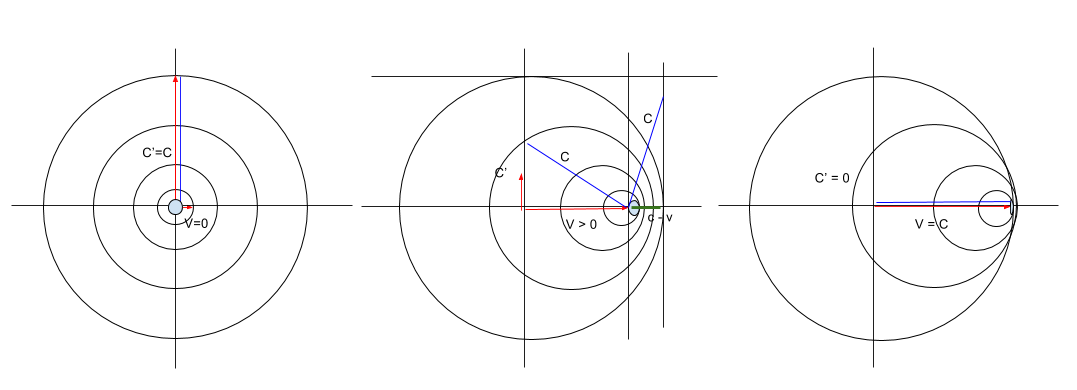 (This diagram is not geometrically correct, meaning the angles and line lengths are not accurate.)
At v=0, no Doppler Effect is measurable.
At v >> 0, a measurable Doppler Effect is present.
And at v = c, the Doppler Effect has reached its “luminous” Mach limit.
What is important to see here is that the geometric Pythagorean representation of competing velocities also represents an aerodynamic/hydrodynamic-like compression of the medium in front of the traveling matter object. The region in front of the craft is called the bow shock, which is compressed medium due to the craft pushing through the medium using propelling force. This compressed medium is then essentially denser compared to the medium’s density if the craft was at v = 0. It is also denser simply because the object is traveling through the medium, and equally the medium is traveling through the object, at a faster velocity. Essentially the pressure and density of the medium on the object’s material structure is proportional to the velocity of the object through the medium. As an aside, this increased pressure and density of the quantum medium due to relative velocity is essentially the mechanistic cause for scaling in my fractal scaling cosmological (FSC) framework of macroscopic objects. Due to this increased density, the mechanistic cause for time dilation gives rise to time dilation and slows time down by a specific velocity dependent functional factor as to have the observer in the craft to still measure the beam of light as traveling at velocity c away from the craft, even though another more stationary observer measures a luminous Doppler Effect between the craft and the leading beam of light, meaning c – v is still measured as c by the moving observer in the craft. Mind boggling isn’t it?…or is it really. Keep in mind the mystery of these effects dissipates as you come to fully realize the mechanistic cause behind the entire dynamic (keep reading).
`c’ = c – v = sqrt(c^2 – v^2)`
In particle accelerators, electric force pushes charged quantum particles against and through this medium. This pushing through the medium can have measurable effects matching the effects mapped by SRT, such as mass increase (MI) and length contraction (LC). But it was time dilation (TD) that really set apart the effects mapped by SRT and those mapped by LET and normal aerodynamics / hydrodynamics. This is very important to note and realize. Why? Because the medium we’re dealing with here is not made of normal known matter like water or air, but is made of the stuff that makes up quantum particles (a literal quantum medium as per FSC). I call it quite justly the quantum medium. In FSC, this medium has an important self-similar fractal property, which gives significant theoretical insight into its composition. This medium is a very highly entrenched medium permeating through all macroscopic material matter objects, to varying degrees, including clocks and human brains. Meaning that an increase in the density of this space-time medium will have a direct effect on the measured and experienced passage of time at the quantum scale up (at the least).
Length Contraction (LC)
Length contraction in particle accelerators is simply an artifact of the medium’s drag experienced on charged quantum particles being propelled by very strong electric force fields in the accelerator, which utilize the particle’s charge to propel it. Essentially the artificially induced electric force propellant pushes the particle against and through the quantum medium whose drag coefficient increases as the particle reaches c. Basically, the electric force propellant is crushing the propelled object against the quantum medium, against the space-time continuum, which essentially flattens it as v approaches c.
At v = c,
`F_{applied} – F_{drag} = 0`
`l’ = l sqrt{1 – v^2/c^2}`
Mass Increase (MI)
Mass increase is caused by the same effect that causes length contraction. Essentially the increasing quantum medium drag makes the object harder to accelerate, even though the applied force to propel it stays the same.
`F_{applied} = m a_{measured}`
`m = F_{applied} / a_{measured}`
The applied force is constant, and the measured acceleration of the particle is fairly easy to obtain in a particle accelerator, but the problem is as the particle reaches c, the measured acceleration falls out of sync with the force applied to accelerate it. This disparity is measured as a difficulty to move the particle due to an assumed increase in mass, though it’s better to call this calculated mass “apparent” mass.
`m’ = m / sqrt{1 – v^2/c^2}`
Time Dilation (TD)
Like I said before, time dilation is really what sets these space-time continuum, quantum medium (qm), effects apart from other known and more tangible types of mediums (ex. water or air). In this application of a very unique version of aerodynamics/hydrodynamics, Time Dilation (TD) is caused because of an increase in the density of the quantum medium (qm) as the object’s velocity v reaches c, where the object starts experiencing an increasing drag due to a aerodynamic /hydrodynamic shock bow compression wave caused by the moving object in the region of the object itself (see diagram above). This increase in density makes all quantum particles in the object more difficult to move, due to an apparent increase in their mass. This includes the electrons in a digital clock and the electrons in a human brain. This includes the atoms in mechanical devices and the atoms in a human body. This increased quantum medium (qm) density directly affects our perception of time mechanically and neurologically.
`density_{qm} = function(v,c)`
`pressure_{qm} = function(v,c)`
`t’ = t / sqrt{1 – v^2/c^2}`
Understanding the mechanistic cause behind Time Dilation (TD) essentially demystifies the effect and time itself.
What is Time Dilation?
Time dilation can be difficult to understand, which is why I’ll dedicate this post to time dilation which is a very real physical phenomena, and not some invention by Einstein. Einstein, and others before him like Lorentz, conceptualized that time wasn’t constant, more so Einstein where Lorentz didn’t fully agree or understand what the mathematics was fully describing. Einstein solidified the concept with his work, which lead experimenters later on to validate his predictions that it existed in the manner he described, without Einstein giving an underlining mechanistic cause, just a superficial geometric description of the effect. Where Einstein’s work stops short (incomplete), my Fractal Scaling Cosmology (FSC) framework explores and explicitly describes a mechanistic cause for time dilation, along with many other things (see https://www.gpofr.com/distortion-time-dilation-experiment/).
What is time dilation? Time dilation is a compensating attenuation on the “normal” passage of time to compensate for the observer’s frame velocity in reference to c, so that the the observer in any frame will always measure c. The velocity of light traveling between different observers, who are themselves traveling at different velocities, travels at a constant c in the same space-time density (quantum medium density as per FSC).
The following diagram is in relation to my own work but touches on SRT and common c in all frames.

I’ll be approaching the topic of time dilation in a slightly different manner mathematically. I personally love a Pythagorean application to derive modified x and t dimensions that mimics the Doppler Effect on the experience of dimension itself. The Pythagorean approach to time dilation gives a view conceptualization of the actual stationary dimension vs. the experienced dimension involved in a simple geometric presentation.
From the Pythagorean diagram above, notice carefully at v = 0 for a stationary observer, c’ = c. This means that our reference to time is through the reference to a constant c, the only true reference. The observer’s velocity doesn’t change the value of c, that is because c in any given space-time quantum medium “material” density (as per my work in FSC) doesn’t change in a non-dispersive medium (source velocity of light source doesn’t add or negate the value of c), and for this to be true along with the observer’s velocity not to affect the measurement of c, that means that the observer’s experience of time must have changed to compensate for his velocity. This doesn’t hold between two different space-time quantum medium “material” densities (as per FSC), but for Special Relativity (SRT) in the same quantum medium density (SRT fits within FSC, as LET fits within SRT). Essentially x’ and t’ are modified versions of x and t dimensions (actually x distance is invariant), and are the versions experienced by a moving observer. Each observer at different velocities in the same space-time quantum medium “material” density will experience different x and t dimensions.
Formulating Pythagorean diagram above:
`c^2 = (x/t)^2 + (c’)^2`
Where c’ is still measured as c within the same frame, because of a modification to x or t dimensions.
`c^2 = (x/t)^2 + ({x’}/{t’})^2`
Since we assume that distance is invariant, therefore x’ doesn’t exist, only x exists.
`c^2 = (x/t)^2 + (x/{t’})^2`
`(x/{t’})^2 = c^2 – (x/t)^2`
`(1/{t’})^2 = (c/x)^2 – (1/t)^2`
`t’ = 1/(sqrt((c/x)^2 – (1/t)^2))`
`{t’}/x = 1/(sqrt((c)^2 – (x/t)^2))`
`{t’}/x = 1/(sqrt(c^2 – v^2))`
`t’ (c/x) = 1/(sqrt(1 – v^2/c^2))` … look familiar?
Since `c/x` derives a time component, since it’s using c and not c’, the time component is considered “proper” time.
`1/t_c = c/x`
`{t’} / t_c = 1/(sqrt(1 – v^2/c^2))`
Finally
`t’ = t_c/(sqrt(1 – v^2/c^2))`
Now how does this visually translate into a scenario of 3 observers measuring the speed of light for a beam of light from their respective inertial frames (in a non-dispersive perfect fluid quantum medium)?

Here c’ is unique to each observer’s velocity in relation to the beam of light, and is derived by:
`c’ = c sqrt(1 – v^2/c^2)`
The calculated value of c’ is still experienced by all observers in their respective velocities as c, and this is because time is experienced differently for each observer in their respective inertial frames due to their respective velocity’s affect on the time dimension.
`t’ = t / sqrt(1 – v^2/c^2)`
So what causes this time dilation mechanistically? From my Fractal Scaling Cosmology (FSC) framework, please read https://www.gpofr.com/distortion-time-dilation-experiment/.
But we’re not finished with SRT. How do the respective observers experience/measure the other observers? This is not a very difficult question to answer. What you have to keep in mind is that the beam of light traveling at c is the common reference in all observer inertial frames.
From Observer A, Observer C is moving away at near the speed of light trailing the beam of light, and Observer C is aging exceptionally slow (clock apparatus moving exceptionally slow in the inertial frame of Observer C). The trailing part is important here. The distance from Observer C and the leading photons in the beam will keep growing because Observer C is traveling at 0.99c. This is good to keep in mind in this scenario.
Now it gets interesting from the perspective of Observer C, and this is where many can get very confused. From Observer C, Observer A appears to be moving away at a velocity close to c, but instead of Observer A aging exceptionally slowly (clock apparatus moving exceptionally slow in the inertial frame of Observer A) from the perspective of Observer C, Observer A is actually aging exceptionally fast yet moving away from Observer C also exceptionally fast. This might appear to contradict SRT at first, but it really doesn’t, because in relation to the beam of light traveling through the space-time medium, through all three inertial frames for each observer, it is Observer C who is actually traveling near the speed of the beam of light, and not Observer A. This becomes even more emphasized when you consider that the space-time medium is a non-dispersive medium, where the source velocity of light does not affect the velocity of the photons (as per FSC), meaning it doesn’t matter which inertial frame is emitting the beam of light (as per SRT). It is very important to cautiously remember, and fully understand, that the beam is common to all frames. Also the distance from Observer A and the beam source will essentially stay the same from the perspective of Observer C in this scenario depicted in the diagram above.
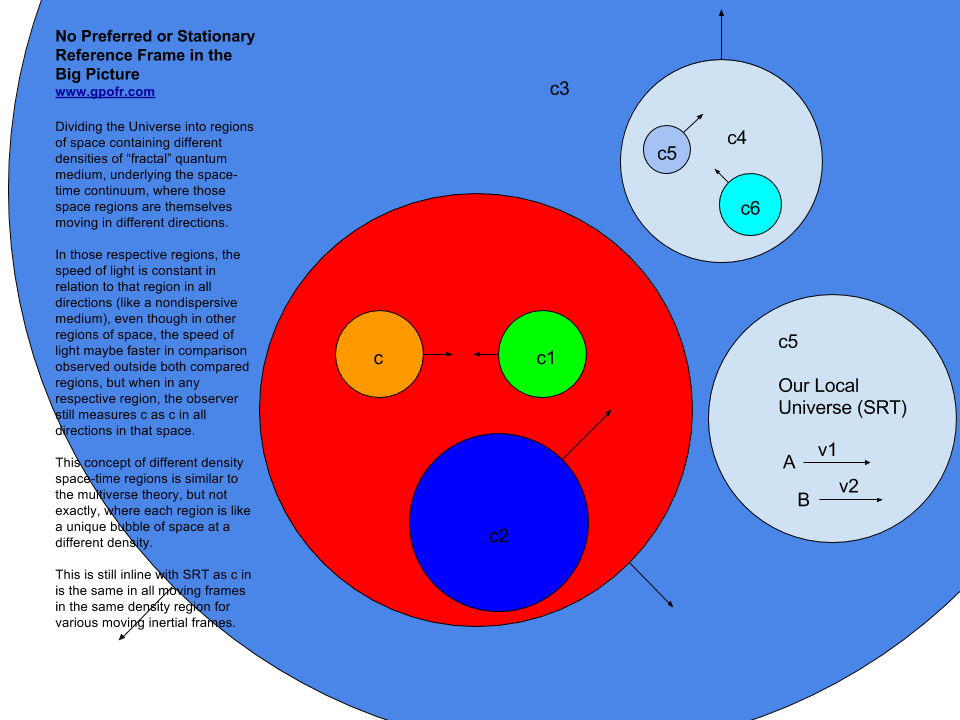
Again from my work in Fractal Scaling Cosmology Framework (FSC), the following diagram depicts that in different space-time quantum medium “material” densities, each respective region has its own value for c, yet each observer will still experience the normal value of c in each respective region because of the medium’s density affect the dimensions distance and time, but not across two different regions. Between two different space-time quantum medium densities, light will experience refraction.
What is Matter and Anti-Matter?
There is a lot of debate around what matter and anti-matter actually are. My own personal belief is that matter, and equally anti-matter, derive from mirrored matter density fluctuations in the background quantum medium, as per my own Fractal Scaling Cosmology (FSC) model, that constitutes the abstracted mathematical space-time continuum model in General Relativity. This dynamic is similar to what John Wheeler proposed in 1955 with the concept of quantum foam. The difference between “quantum foam” and FSC’s “quantum medium” is the very explicit description of the quantum medium’s constitution that the “quantum foam” description lacks. This description of the quantum medium is very explicit, predictive and extremely fundamental because it was derived unavoidably by the laws of fractal mathematics. This quantum medium (qm) is itself made up of the matter that constitutes quantum particles, with some very explicit and special properties, and more so because it’s fundamentally fractal.
Much of this debate, at varying levels, believes in some variation of matter deriving from a background “aetheric” medium that fills all of space, and much of it uses pair production of matter and anti-matter to argue this. One particular alternate “aetheric” model using the pair production argument is the electron-positron model (e-p model), of which there are varying models with different explicit details. Here I’m generalizing all such models for the sake of simplicity. The problem I find with these models are that they fail, at least to my own understanding, to explain the mass of quantum particles, such as an electron, or properly describe how vector velocity trajectory is maintained. The reason why I have issue with this model is that the electron, and positron, in some models, are themselves the fundamental constituents of the “aetheric” medium, and because of this, it raises some very fundamental issues.
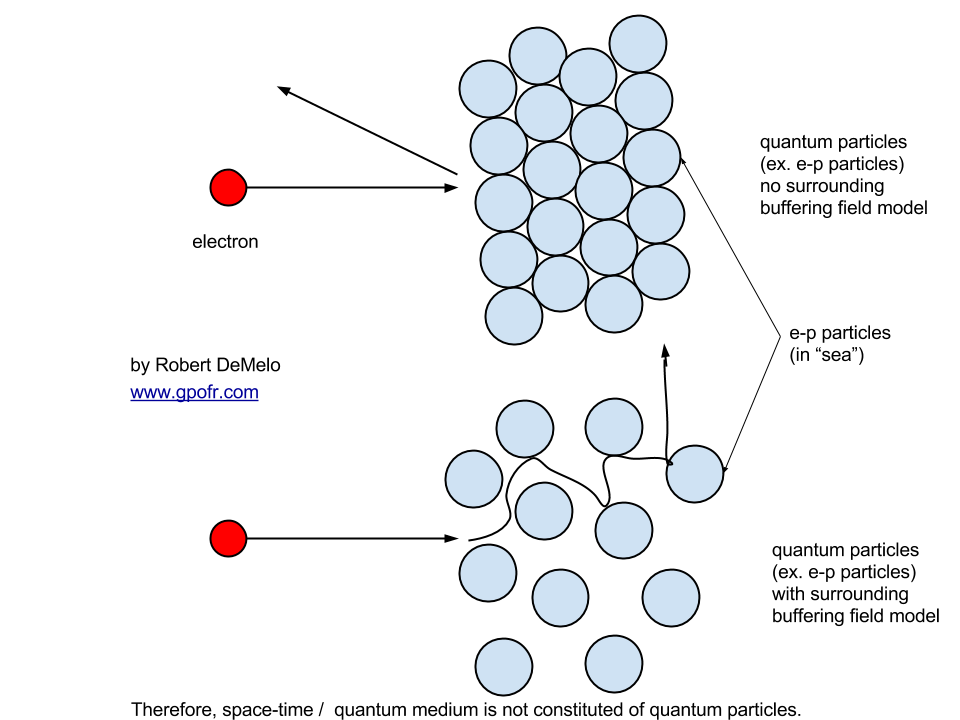
My own quantum medium (qm), in the my Fractal Scaling Cosmology (FSC) Framework, is also this “aetheric” medium that is also equally space-time, meaning density variations in the matter density of the background quantum medium (qm) additionally distorts the experience of distance and time, which means it’s inline with Einstein’s GRT. The difference between the FSC quantum medium and GRT space-time medium is that the FSC quantum medium is described much more mechanistically and fundamentally, which GRT is not, but it does not mean they are describing two different things, which they are not. They are describing the same thing in different ways, where GRT is superficially geometric, and FSC is far more mechanistically fundamental. This quantum medium (qm) is constituted of self-similar sub-quantum particles that resemble quantum particles self-similarly but are much much smaller than quantum particles themselves.
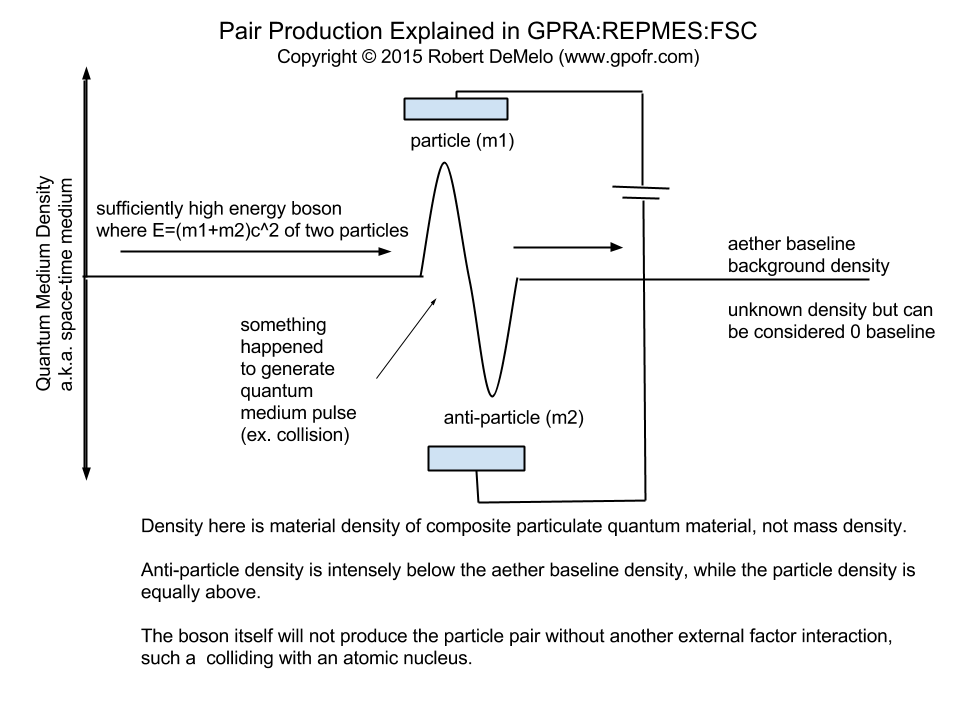
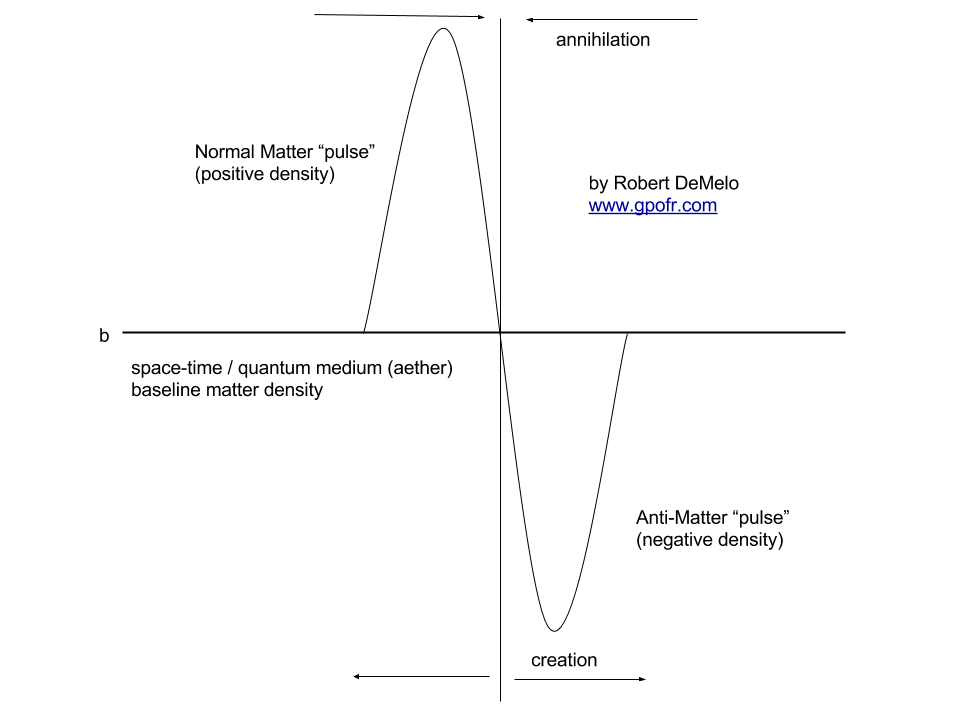
In FSC, annihilation is a destructive wave interference of two mirrored pulses in the “aetheric” medium (quantum medium, space-time continuum) of positive and negative matter densities of equal(ish) amplitude. These “aetheric” medium pulses can be considered, or described, to a certain degree as an “energy” substance, but they’re not. It’s a fundamental matter construct of “dips” and “rises” of quantum medium matter density containing energy. The energy causes and maintains these pulses. These pulses containing energy cannot be erased from existence, only converted, therefore they can exist from long periods of time until encountering destructive interference patterns. In my own FSC quantum medium, this fundamental matter is constituted of sub-quantum particles, fractally self-similar to quantum particles themselves, but much much much smaller. After annihilation, the quantum medium pulse generated (boson with explicit properties) has far more velocity than its prior annihilated quantum particle constituents, maintaining the conservation of energy.
To help understand these concepts and arguments, I’m providing the following diagrams:
Reference:
1) Wikipedia, “Quantum foam concept“, Retrieved 2012, https://en.wikipedia.org/wiki/Quantum_foam
2) Wikipedia, “Pair Production“, Retrieved 2012, https://en.wikipedia.org/wiki/Pair_production
3) Mauritsson (2008), “Coherent Electron Scattering Captured by an Attosecond Quantum Stroboscope“, Phys. Rev. Lett. 100, 073003, https://www.researchgate.net/publication/5498988_Coherent_Electron_Scattering_Captured_by_an_Attosecond_Quantum_Stroboscope
Distortion & Time Dilation Experiment
Here is a simple time dilation experiment documented in my own research work Fractal Scaling Cosmology Framework (FSC) since 2008. It’s based on space-time having an aerodynamic/hydrodynamic-like fluidic characteristic allowing for wave bow shock and tail. The bow shock region in front of a moving inertial body will have denser fractal quantum medium (space-time continuum material density), and the wave tail will be less dense. The difference between the two quantum medium densities, caused by movement compression distortion of the medium, can be used to give a potential difference between the two densities, and manifests as a dilation in time between time measurement instruments placed in the two respective density regions of a moving inertial body (in the bow shock, and in the tail). This distortion is attributed to cause and effect. The artificial propulsion of the inertial body pushes and moves the body through the quantum medium, displacing the quantum medium at the quantum scale, forming a wave bow shock and tail around the body as the medium restricts (impedes) the body’s movement when in acceleration. The denser the inertial body, the greater the distortion of the quantum medium.
To do this simple experiment:
1. get two identical digital clocks
2. get water proof enclosures and place the clocks inside them securely with adhesive
3. synchronize the clocks
4. then securely place one in front of your car’s front bumper
5. securely place the other in the back of your car’s back bumper
6. then drive around for a month, or ideally go on a lengthy road trip of 100km/h.
The denser the car’s metal construction, like cars from the 50s, the better for this experiment. Also the faster you drive, and the longer the travel, the better for the experiment. Remember that a car travel’s at extremely low velocities in comparison to the speed of light, therefore if the very small compounding effects of a car pushing and ripping through the space-time continuum fabric on the surface of the planet will take a very long time to accumulate enough very small incremental time distortions to finally be measured as an observable time deviation…time dilation. The numerous acceleration phases of the car will also have a compounding effect.
To understand how small an impact a car will have generating time dilation by moving at conventional road speeds and accelerations, let’s take a very appropriate analogy of water representing the quantum medium (space-time continuum). At 20C, the speed of sound in water is c_w = 1482 [m/s]. If we were to equate c_w to the speed of light c in a vacuum, then traveling at 100 [km/h] in a vacuum would be equal in ratio to traveling through water at 0.0001372 [m/s] or 0.000494 [km/h]. It is very easy to see that traveling at 0.000494 [km/h] in water would hardly produce any compression density distortion in the water forming a bow shock and tail regions (no matter how slight), because the area around the moving inertial mass would be filled in by the water faster than the object is actually moving. The medium is “malleably” faster than the moving object. This gives Einstein’s SRT a far easier depiction to understand what’s happening. But even given this, there is still a very slight compression distortion as an inertial body pushes through the medium that would accumulate by synchronized digital time measurement devices over time, at least in theory.
If time dilation is true, the two clocks will deviate after the experimental run.
To give the dilation an average distortion factor for the experiment:
(1) D = T_front / T_back
To prove time dilation, D has to be non-zero (D < 0 < D). The formulation of D in relation to acceleration and velocity is part of my research work in Fractal Scaling Cosmology (FSC). The unit used for D is arbitrary since dimension is canceled in ratio of the same fundamental dimension, but one is given [melo] to describe this factor as a distortion potential value due to an inertial object’s movement.
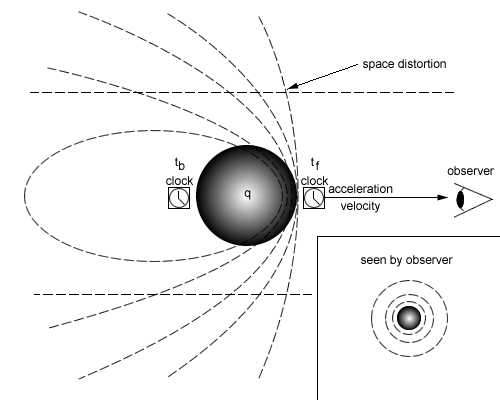
Figure 1: Distortion Time Dilation Experiment, to prove Space-Time material composition, the underlying quantum medium, is a fluidic medium lending to aerodynamic and hydrodynamic like properties and characteristics.
This experiment is simple and works on the extended hypothesis that the space-time continuum has aerodynamic fluidic properties that affect the passage of time, and subsequently the measurement of distance.
Additionally several configurations (ex. controlled lab, better environmental shielding) and testing cycles can be done (ex. flipping the clocks in different test runs to rule out mechanical issues). More configurations of this experiment can be invented applying the same simplicity.
Another experimental configuration is using a lead block attached to a centrifuge armature mechanism with one clock in front of the block, and another synced clock on the back of the block.
Bottom line, time dilation exists. It’s empirical fact. Whether it meets SRT formulations exactly is another question.
What my experiment attempts to measure is a difference factor in dilation between two seemly equal frames where one is shielded in the direction of movement by a fairly dense inertial body, and the other is far less shielded.
And to prove time dilation, this factor has to be D < 0 < D. A non-zero value proves time dilation exists. Giving D a scale proportional to acceleration and velocity is what my own research work involves.
But this isn’t the only thing this experiment would prove if D is not zero. A non-zero D value in the context of this experiment additionally proves space-time is fluidic, which proves the technical implication of the GR continuum field equation, which appears based on the perfect fluid continuum field equation.
Additionally, the use of digital clocks is to mimic the human brain, because these clocks use electrical currents composed of electrons (quantum particles) to transmit signals, just like in a human brain. Therefore the space-time environmental affect on these clocks would also affect human neurological processes, and microscopic human biological body functions near the quantum scale, in the same way…all of it affecting the perceived passage of time.
To clarify, and right out my own work, if the quantum medium’s material density were to increase, movement of quantum particles would be further restricted, would be slowed down, and their inertial mass would increase also (…relatively), and that goes for electrons in the clocks in my experiment, as well as for electrons in the human body and brain.
Which leads to the philosophical question of what time is exactly?? You see, when searching for fundamental answers, and finding them, at least believing to have found them, the mystery is gone, as in the mystery of time. What I’ve essentially described here is the demystification of time itself by giving time dilation a fundamentally mechanical explanation, the manipulation of restricting or loosing the execution of sequential events. In this case it’s the restriction of quantum particle movement, which affects macroscopic constructs made from quantum particles.
The mystery of time dilation is not mutually exclusive from the existential environmental quantum effects (via the “fractal” quantum medium), in the exact same way electronic clocks are affected by external environmental factors (in a vacuum).
Vikings and Norse Mythology Linked to Ancient Mesopotamia
I wrote an insightful short book on Norse myth and ancient Mesopotamia back in July 2014, and then archived/shelved it thinking it was complete “enough” so I could enjoy the Summer and focus on other things, but I ended up continuing until this year. I finished the updated version of my book (version 2 technically). I believe it will definitely interest some people. Any Lord of the Rings fans? Any Norse mythology fans?
Link to Norse Mythology Rooted in Ancient Mesopotamia
This work brings many myths down to Earth giving them a previously unknown plausible reality while keeping them still fantastical.
Was Thor real?
Who was Loki really?
Where is Asgard located?
Where is Yggdrasil located?
Who were the Vikings?
What really happened to the gods?
What really were the Nephilim?
Researching and writing this was very enlightening for me personally. I didn’t start it as a serious work, more of a leisurely pastime exploring something that had been on my mind for awhile, one of those hunches, but in the end it became something rather compelling and serious for me as the dots started connecting.
The way I see it, of the sciences, physics is perhaps the most fundamental, which is why it intrigues me beyond measure, but there are other fundamental aspects of human existence that lay somewhat outside the natural sciences, like our history. This is why history interests me. Undeniably, the application of science in history research is paramount, but precarious when it comes to historical context and interpretation. This requires we continually question our assumed factual beliefs, that we “not become enthusiastic for the fact, the knowledge, the absolute truth of the day, but remain always uncertain.” This is what I hope my book helps others to explore given its specific subject matter.
Enjoy.
Relativity Lorentz Factor Curvature is a Mach Drag-Coefficient Curvature for the Space-Time Medium
In my last blog post, I gave my reasons for supporting Einstein’s theories irrespective of alternative or mainstream beliefs (everything should be questioned and not blindly followed). In that post I also elaborated on the underlining mechanism that derives the phenomena that Special Relativity and General Relativity Theories mathematically map as expressed in my own work (Fractal Scaling Cosmology, GPRA:REPMES:FSC).
More recently I posed a question to another independent researcher/scientist of “What the Special Relativity (SRT) Lorentz Factor physically represented?” The Lorentz Factor in SRT initially mapped theoretically a unique dynamic of travelling through space that was required to resolve the disparity between Maxwell’s framework and the constant speed of light irrespective of light source velocity. Specifically it was the ingenious application of time dilation with the Lorentz Factor that resolved this disparity. Latter this SRT Lorentz Factor dynamic, or more correctly, this physical phenomena, was confirmed in numerous experiments as particles became harder to accelerate to higher velocities nearer to c (in particle accelerators). So what causes this phenomena that SRT Lorentz Factor (Lorentz and Einstein) so famously mapped at the beginning of the 20th century? As an aside, many people are not aware this is an actual physical phenomena, and/or somehow never disassociate it from the theoretical nature of Special Relativity (SRT), as if SRT produces this phenomena. SRT does not produce this phenomena, it only predicted it.
In answer to this question of what the physical representation of the SRT Lorentz Factor is, in my last research book (identifier GPRA:REPMES:FSC 2012/2013) I research and explore the REMARKABLE similarity between the drag-coefficient in a fluid/gas at Mach 1 and the Lorentz factor curvature found in LET and SRT; specifically the portion of curvature upto velocity c. Making this connection was extremely insightful. I shared this info sometime ago in a discussion email forum (in reference to my research found in my book). If the two curves are a result of a similar type of dynamic, this explicitly means mass increase in SRT is NOT solely attributed to “pushing” against/through the space-time medium (the modern non-classical aether) and solely experiencing drag as some have proposed (including myself), because that doesn’t explain the constancy of velocity through empty space after acceleration as this would require the space-time medium to be essentially friction-less (no viscosity at low velocities). Some of these premature propositions of aether dragging causing the Lorentz Factor curvature do not speak to the attributes of space-time that are REQUIRED to match this measurable curvature. Space-time is essentially friction-less, which along with GRT’s description space-time describes a **non-dispersive friction-less super-fluid**. This description is not the classical aether. Aether theories are not all the same and do not all suffer from the same ailments, but there is a distinctive line between classic and modern aethers. For example, between Robert Boyle’s, Maxwell’s electromagnetic field and the more modern Einstein’s GRT space-time continuum, SVT’s superfluid medium (inline with GRT), and even to an extent the Higgs Field. To highlight the need for an explicit description of this modern space-time aether medium in order to avoid ambiguities with erroneous classical models of the aether, air resistance applies to all velocities where space-time medium resistance appears to ONLY apply to velocities nearing c, because my research suggests that the space-time medium’s drag-coefficient changes when nearing those velocities, similar to physical fluid/gases. This doesn’t speak to the fact that space-time medium’s resistance increases proportional to acceleration (as described in GPRA:REPMES:FSC). If the Lorentz Factor curvature is a result of a similar dynamic that causes drag-coefficient curvature near Mach 1, this means that this curvature is caused by an inherent property found in fluid-type mediums in which objects travelling in them approach the non-dispersive fluid’s wave velocity changing the fluid’s “viscosity” at those near c velocities upon the object.
Furthermore, AND MORE IMPORTANTLY, this insightful connection between the SRT Lorentz Factor curvature and the Mach drag-coefficient curvature also STRONGLY predicts/suggests the Mach 1 light speed c is not a hard velocity limit at all if fractal self-similarity applies to the space-time aether (quantum medium as explicitly described in FSC). FSC strongly suggests velocities beyond c are very real, exist and are achievable.
This insightful understanding upon this dynamic also reveals something about relativistic mass. Mass increase as described in SRT is based on apparent mass and not rest mass which remains the same at any velocity (if the observer travels parallel to the object). As an object is propelled by an artificial mechanism (ex. rocket) using natural forces (electric, magnetic), as the object approaches c of the medium, the mediums drag-coefficient increases changing the state of the medium’s friction-less viscosity making it more difficult to push the object therefore requiring more force applied. That increased applied force is where the extrapolated *apparent* mass is derived from. It’s simple and simple math and doesn’t only apply to the theoretical aether, but all fluids of which gas and solids are still at different bulk modulus through temperature. The *measurable* mass (apparent mass) changes with velocity, but I stress this apparent mass is relative to the observer’s own velocity, so a moving mass as measured by two differently moving observers will not measure the same. This two observer scenario is difficult to reproduce, but in a particle accelerator, the single observer scenario is very real and has been verified.
Particle accelerators use an electrostatic field to attract or push charged particles. The electrostatic field strength on a charged particle is 10^39 times stronger than gravity. Gravity propagates at c though the space-time medium. If the particle accelerator were to use gravity alone to accelerate a particle, it would never reach c due to the gravity field propagation matching parity at c with the particle’s velocity if the SRT Lorentz Factor effect is ignored. The electrostatic field is again 10^39 times stronger than c. There is no shortage of force to propel a charged particle. In addition, in my own work in fractal scaling cosmology (FSC), fractal self-similarity predicts that the electrostatic field is self-similar to the gravity field but propagates much, much, much faster than c (9×10^16 m/s as per FSC). In both cases, electrostatic field would not meet parity at c, so when a particle becomes more difficult to accelerate near c, it’s not due to a lack of strength or speed from the propelling mechanism.
I know Einstein is correct when it comes to his less than fundamental theories because of the SRT Lorentz curvature matching Mach speed drag-coefficient curvature (as per my GPRA:REPMES:FSC work), and due to his ingenious topological (high-level, non-fundamental) GRT gravity theory.
Propositions and arguments that use an arbitrary “classic-type” aether in place of the more modern space-time continuum model (new aether) and then claim that the aether causes apparent mass increase due to an aerodynamic-type of mechanism while adamantly insisting or suggesting Einstein’s SRT is incorrect though it uses the Lorentz factor (which is applied correctly) and matches empirical data is completely illogical given the insight described above between SRT Lorentz Factor curvature similarity to Mach drag-coefficient curvature. Essentially, Einstein is describing in mathematical terms what the aether argument applying drag is explaining BUT in a friction-less super-fluid without the explicit reference to such a medium. The two arguments (pro classic aether and pro space-time continuum) are not mutually exclusive (there are no sides in proper science). The grounds upon which they can meet correctly and explicitly MUST match empirical data, and there is a narrow corridor for this deterministic aether unification with the more modern space-time continuum as described in my research in FSC.
Due to increased popularity with the aether concept in recent times, arguments of whether Einstein is wrong with SRT or GRT is irrelevant when it comes to the measurable phenomena that these theories describe. The argument that should be argued and advanced of SRT is what causes the SRT Lorentz curvature physically real phenomena? SRT itself doesn’t explain the fundamental why. It doesn’t explain the mechanism underneath the dynamic mathematically mapped in SRT, but LET does to a degree. SRT, as GRT, is NOT a fundamental theory. These theories, like many theories in science, are topological (high-level), a mapping of a measurable dynamic, or in Einstein’s time, the only explanation to the disparity between Maxwell’s framework and the measurement of the speed of light irrespective of source speed, which turned out to be correct on several aspects (research supporting experiments).
Einstein undeniably based his work off LET. LET is undeniably an aether theory, therefore Einstein’s use of the Lorentz factor indirectly introduces an “aether” medium into SRT even though it did not explicitly mention it (see Aether Theories). The difference in SRT and LET aethers is that the SRT aether is indistinguishable from the experience of space, while LET’s aether was classical and theorized to be separate from the experience of space (immovable), and therefore could in theory be detected and measured. GRT nailed this fact home with the space-time continuum.
Knowing this about Einstein’s SRT and GRT, scientists (independent and not) could REALLY start to advance science by looking at the fundamentals of nature that give rise to SRT and GRT models and the phenomena they explain. For example, the space-time continuum isn’t as fundamental as it could be. The SRT Lorentz factor curvature doesn’t explain what causes it, and GRT doesn’t fundamentally explain what exactly is “curved” space (see Schwarzschild solution) or what causes “curved” space. The space-time continuum doesn’t describe its intrinsic, constitutional physical nature at the quantum and Planck scales (or smaller as predicted in FSC). SVT (superfluid vacuum theory) attempts to explore and explain this more fundamentally yet it’s still not fundamental enough. This is what I’ve been doing with fractal scaling cosmological framework (FSC) because the framework is extremely fundamental. In fact, FSC CANNOT be more fundamental by its very nature. But this advancement in science will never happen if scientists (independent or mainstream) are too married to their deeply ingrained beliefs (conservative or the other) or the systems these beliefs uphold.
In addition to these fundamental explanations that are missing from SRT and GRT, which if explained would advance science beyond SRT/GRT (not prove them wrong, but only incomplete), there are legitimate problems with SRT and GRT that if answered would also advance science.
Here is my list of SRT/GRT problems:
1) Is the light speed limit assumption correct? It was an assumption, and the lack of evidence for superluminal speeds isn’t evidence against it. Quantum entanglement is faster than c by upto 10,000 times (if not more). Also the Lorentz factor curvature matching the Mach drag-coefficient curvature (as described in GPRA:REPMES:FSC) strongly suggests that superluminal speeds are very real IF repeating fractal self-similarity in nature is real (nature is undeniably fractal so it isn’t a far stretch).
2) What is causing the spiral galaxy velocity curvature? GRT requires Dark Matter to explain it, again on a more topological level (high-level). The composition of Dark Matter hasn’t been discovered yet. In my research in FSC, I suggest that Dark Matter and Energy are related to the explicitly defined fractal quantum medium (QM) decribed in FSC. If correct, this would mean that no detectable *invisible* quantum particles will be correctly discovered in attribute to Dark Matter or causing Dark Energy. Instead density changes in the quantum medium (ambiguous with the experience of space) would be attributed to this phenomena.
3) What is the space-time continuum? GRT gives a field equation that essentially maps a medium that is pliable, moves, curves and swirls (Lense-Thirring Effect). Similar continuum field equations are used to describe an ideal fluid, which indicates that Einstein modeled the space-time continuum after an ideal fluid, which actually supports the matching Lorentz factor curvature with Mach drag-coefficient curvature (from GPRA:REPMES:FSC), because drag in an ideal super-fluid (SVT) doesn’t really exist (lack of viscosity) but does come into play near c because something in the medium changes at those velocities. In FSC, the space-time continuum is given an explicit description as the fractal quantum medium (QM), which not only describes the dynamic of gravity but also electric force.
General Relativity Field Equation Represents a Physical Fluidic-Type of Medium
There is much confusion around Special and General Relativity. I admit some years ago, at the beginning of my own research into what is currently better defined as fractal scaling cosmology (FSC), I was initially taken in by arguments of dissenting researchers that SRT and GRT were erroneous, because at the time there appeared to be a contradiction between my own work and SRT, but that never sat well with me. I avoided the subject of reconciling FSC with SRT and GRT in favour of bettering my own framework in FSC independently, separate from all external schools of thought, by strictly applying my S scaling factor, and associated transformation equations, to various physical phenomena and testing whether it was correct after application. Part of that research involved projecting Newtonian gravity at the quantum scale resulting in Coloumb’s charge force law (analogical to Newton’s gravity law). This was a very slow process, and it eventually evolved unavoidably into the development of a fractal material spatial medium called the fractal quantum medium (or simply QM). It was only after that development came the day that I had to reconcile SRT and GRT by necessity. What was that necessity?
What sparked this reconciliation was that after developing FSC to a specific point, I noticed that FSC core framework had an additional effect on Newtonian gravity. It was an extension on Newtonian gravity by applying FSC’s core framework to classic gravity dynamic. In applying this modification, a new gravity equation emerged that reduced to Newtonian gravity equation, was very consistent with it, but also added an additional effect. The equation was put into a gravity computer simulation test which resulted in the additional visual effect of orbital precession. Upon seeing this, I had to test the new equation with empirical data of our Sun and Mercury. What resulted was the orbital precession of Mercury precessing by 43″/century. The simulation ran 100 years of Mercury orbiting the Sun by accelerating the passage of time so the simulation took minutes not years. I ran the test many times resulting in the same value. In compound to other fascinating results in the FSC framework (deriving the elementary charge, giving the explicit cause of inertial mass), this for me solidified that FSC was indeed on the right path, or at least it was partially very correct.
Upon getting this unexpected result from a framework that appeared at first detached from General Relativity (GRT), it forced me to look more closely at General Relativity. I was most curious was how my own FSC framework and GRT resulted in the same result using mathematical frameworks that appeared fairly exclusive from each other. This bothered me, but my first step was to verify that GRT was indeed correct. This might seem arrogant to some that I needed to verify GRT was correct, but proper science demands no less. You have to question and test everything indefinitely. Ultimately I found GRT correct to a point. One such weakness in the theory is its inability to explain the spiral galaxy velocity curve without the addition of a non-verified dark matter. Another problem is its inability to integrate with quantum theory and mechanics. But given these short falls, General Relativity has proven itself empirically on several aspects.
During my studies and research in the history and mathematical framework of GRT, I realized (some time ago now) that the GRT field equation represents a physical medium with fluidic properties. It was this that initially made me very curious about physics as far back as 1992. In fact, the GRT field equation has many undeniable similarities to the “Perfect Fluid” field equation, which makes you wonder if Einstein used the “Perfect Fluid” field equation as the source for GRT’s field equation. This medium was called by Einstein the space-time continuum. The word “continuum” comes from the mathematical framework/language used by Einstein and associates to describe this medium, which is called Continuum Mechanics. Continuum Mechanics is used to describe the embodiment of dynamics of mediums such as water, concrete, and elastic jelly. The GRT field equation describes a medium that can propagate waves and is locally movable (draggable as per the Lense-Thirring effect). What was most astonishing was that GRT was not independent of older theories of a universal aether. Einstein was a big admirer of Henry Lorentz, who with others developed the Lorentz Ether Theory (LET) framework. Einstein used portions of LET in his work with Special Theory of Relativity (SRT) in 1905, but because of how SRT was devoid of an explicit aether as LET had, SRT and Einstein essentially renounced the existence of a classical aether as it was defined at the time. Later upto 1916, he developed GRT incorporating SRT. Upon revealing the GRT field equation to the scientific community, Lorentz challenged Einstein by stating that in GRT Einstein re-introduced the aether (as space-time) he previously claimed to no longer exist. Einstein replied by stating that space-time was a “new aether”. To this claim Einstein is correct. GRT’s space-time medium is not the LET aether. First it incorporates time-dilation which LET’s aether does not, and secondly is it movable while the LET aether is immovable. Either way, what is obvious is that GRT’s space-time has a geometric mathematical representation describing a medium that is physically real in some form. It also describes a medium that is essentially ambiguous from the experience of space itself, mainly due to how it bends light, which is our primary “human” means of observation. What GRT does not describe is what the space-time medium is made of. It doesn’t describe its material composition. Because of this lack of description, GRT has problems reconciling with Quantum Mechanics. This is where FSC comes in with a very explicit description of the this space-time medium, which is called the fractal quantum medium for very just cause, but this is getting beyond the current subject. GRT also lacks the description of why it appears not to impose drag on objects moving at a constant velocity, and it lacks the description of what exactly space-time curvature/distortion physically represents and how exactly curvature is caused by the introduction of a mass object. Like SRT, GRT lacks deep underlining mechanistic causes for the effects and dynamics it maps. This is where Superfluid Vacuum Theory (SVT) was introduced back in 1952 in the form of Bose-Einstein Condensate (BEC). SVT attempts to gives mechanicals causes to the what GRT embodies in the space-time medium, and in so trying, it also tries to unify GRT with Quantum Mechanics. In my opinion, it does a good job to a degree but ultimately fails. SVT embodies many older aether concepts, such as LeSage’s mechanistic gravity cause, but in a different language. SVT explicitly describes GRT as a fluidic medium with superfluid properties while giving more underlining causes, while GRT field equation describes essentially just a fluidic medium without giving underlining causes. FSC gives very explicit underlining causes for most dynamics space-time is attributed with, such as gravity. FSC breaks it down to the quantum scale.
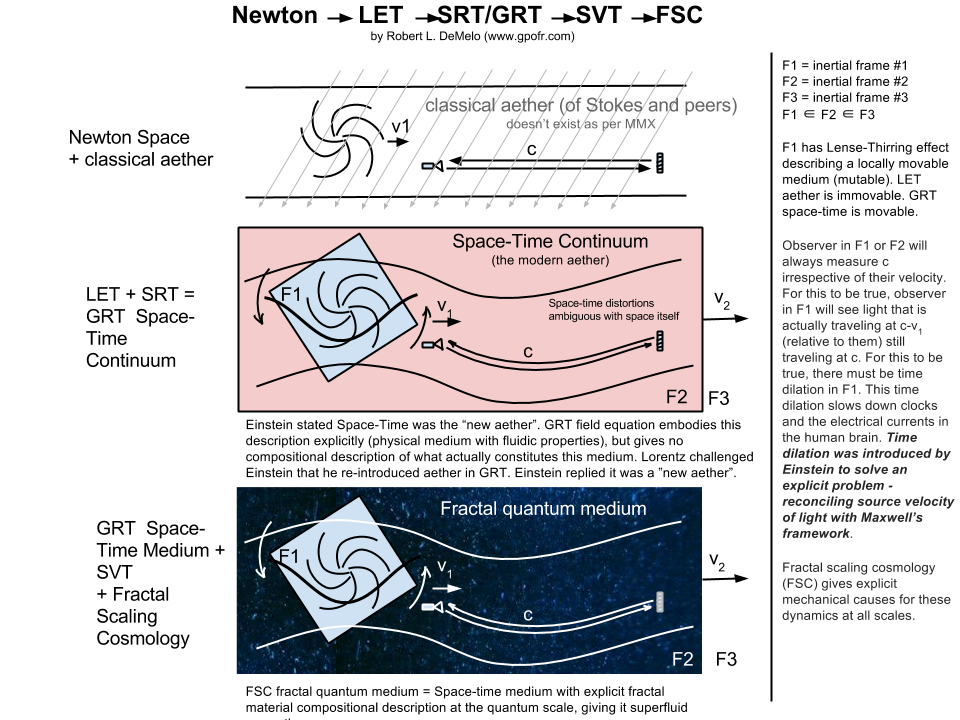
For proponents of classic LET (and I admire LET framework for its connection to GRT space-time), LET was never expressed in continuum mechanics, as far as I know, but GRT definitely was. This means that GRT space-time “aetheric” medium has a better explicit description of its physicality than LET aether ever had. LET is the more explicitly obscure aether medium between the two, therefore most prone to erroneous interpretations. Math is a very explicit language. Also GRT space-time is movable and LET ether is immovable. LET was primarily expressed as an alternative to SRT without time dilation using instead size/length contraction as a means to reconcile light source velocity with Maxwell’s framework. GRT incorporates time distortion (and length contraction) which is proven without any doubt that a gravity field affects time. How it affects time, the explicit way, maybe questioned. LET has no such description of time dilation. Time dilation was Einstein’s primary contribution.
Also c=1/sqrt(ue), where u is the vacuum permeability (or magnetic constant) and e is the vacuum permittivity, which means many scientists are fully aware that light speed is dependent on the intrinsic properties of the spatial medium (space-time continuum).
Gravity as a push effect by the spatial medium is described by GRT explicitly if you take Schwarzschild solution and apply it in 3D geometry as a pressure-density gradient producing force (gravity).
And to answer the question of if space-time is a physical medium, a fluidic solid of sorts, why doesn’t it stop physical mass objects from moving inside it? Because it has super fluidic properties. GRT expressed no frictional aspect but did express space-time “curvature” generating force. Friction/drag is also a force.